
The 1937 Mercury dime Value identification remains strictly dependent on grading precision and mint mark verification.
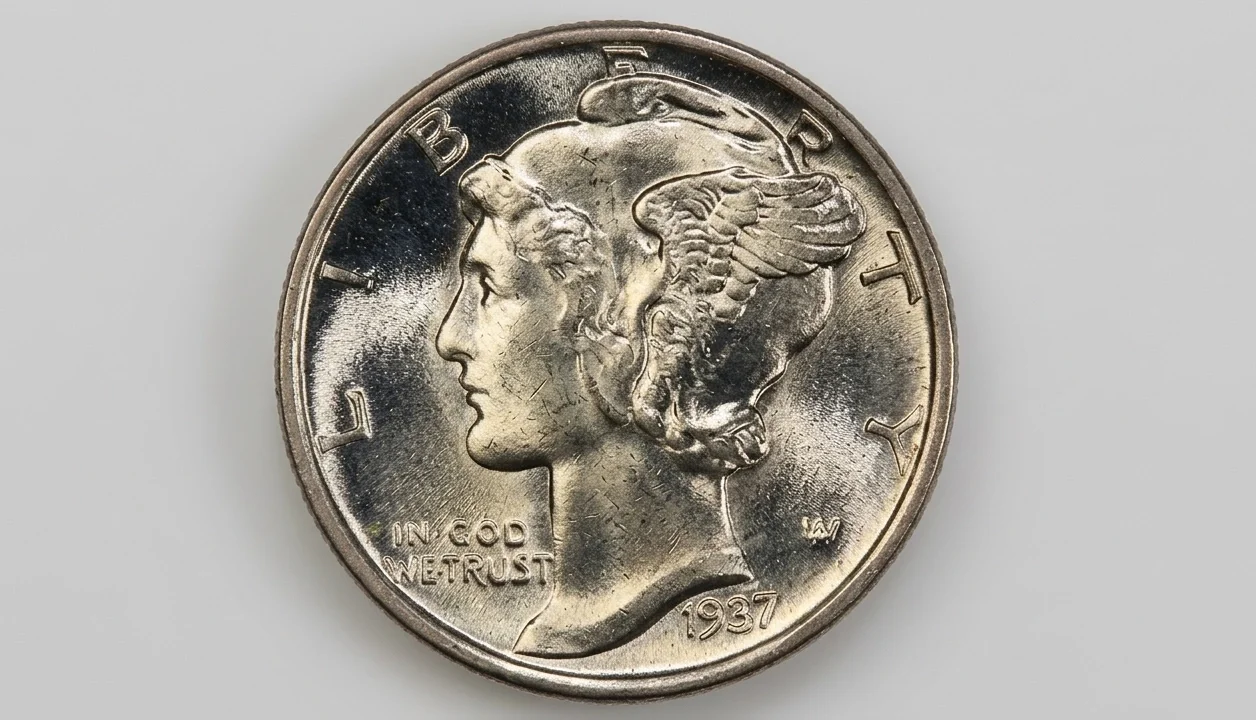
Minting Distribution by Facility
Production in 1937 occurred at three primary locations.
Total output exceeded 80 million units.
Precise figures for each facility appear below.
- Philadelphia (No Mint Mark): 56,850,000
- Denver (D): 14,146,000
- San Francisco (S): 9,740,000
Cumulative mintage → 80,736,000 units.
Standardized minting protocols ensured uniform currency mass.
These parameters remain critical for identifying counterfeit or altered samples.
| Parameter | Value |
| Metal Content | 90% Silver, 10% Copper |
| Weight | 2.50 grams |
| Diameter | 17.90 millimeters |
| Edge | Reeded |
| Die Orientation | Coin Turn (180 degrees) |
Total pure silver content equals 2.25 grams per unit.
The Full Bands (FB) Designation Factor
The Full Bands criterion defines collectible premiums exceeding standard numeric grades.
Presence of clearly separated horizontal lines on the reverse fasces indicates maximum striking pressure.
Frequency of this trait varies according to the mint location.
Philadelphia (1937) → High FB survival rate due to superior die preparation.
Denver (1937-D) → Moderate FB occurrence.
San Francisco (1937-S) → Rare combination of sharp strike and surface preservation.
Missing band separation → 40-60% value reduction.
Distinct band separation → Exponential price growth for grades exceeding MS65.
Price Records and Market Dynamics
Market valuations for 1937 dimes correlate with PCGS, coin finder, and NGC population reports.
Investment viability finds support in auction realizations from the current 2024-2026 cycle.
Philadelphia (1937) Sales Statistics
Verified data for top-tier specimens:
- MS68+ FB: Sold in late 2025 for $16,400.
- MS68 FB: Average realization holding at $4,200.
- MS67 FB: Trading within the $450 – $650 range.
Annual appreciation for MS67 FB grade → 4.5%.
Price volatility for mid-grade samples (MS63-MS64) → under 1.2%.
Denver (1937-D) Statistics
Denver strikes frequently display superior surface luster.
- Record (MS68 FB): $7,800 (Verified 2025).
- Population in MS68: 14 confirmed units.
- Supply deficit in the highest tier → 13% price increase over 5 years.
San Francisco (1937-S) Statistics
San Francisco recorded the lowest output for this year.
- MS68 FB: Realized $6,950.
- MS67+ FB: Trading at $1,350.
- MS66 FB: Entry-level collector segment priced near $280.
Value Correlation by Grade
Market price shifts between grades follow a non-linear trajectory.
| Grade | 1937 (P) Price | 1937-D Price | 1937-S Price |
| MS64 | $32 | $36 | $40 |
| MS65 | $50 | $55 | $62 |
| MS66 | $75 | $90 | $110 |
| MS67 | $175 | $250 | $385 |
Current figures apply to specimens lacking the Full Bands attribute.
FB designation increases these values by 2.5x minimum for MS66+ tiers.
Proof Strike Characteristics
The US Mint continued special quality production for collectors in 1937.
Mintage totaled 5,756 units.
Manufacturing occurred exclusively at the Philadelphia facility.
Distinguishing Proof features:
- Mirrored fields on obverse and reverse.
- Absent flow lines or die polish marks.
- Squared edges on all relief elements.
2026 Proof Price Points:
PR68 → $9,800
PR67 → $2,100
PR65 → $650
Ten-year value trend → 21% cumulative increase.
Finding haze-free surfaces drives significant premium acquisition.
Varieties and Minting Errors
Strictly cataloged 1937 errors alter the pricing structure of specific lots.
Doubled Die Obverse (DDO)
The most prominent variety involves doubling on the obverse.
Visible thickening affects the “IN GOD WE TRUST” motto and date.
Production cause → Improper hubbing during die manufacture.
Economic Effect: Doubled Date → 300% price premium. Doubled Motto → 150% price premium.
Die Clashes
Common technical occurrence for the 1937 mintage.
Reverse wing contours appearing behind Liberty’s profile on the obverse.
This feature rarely carries a premium unless exceptionally pronounced.
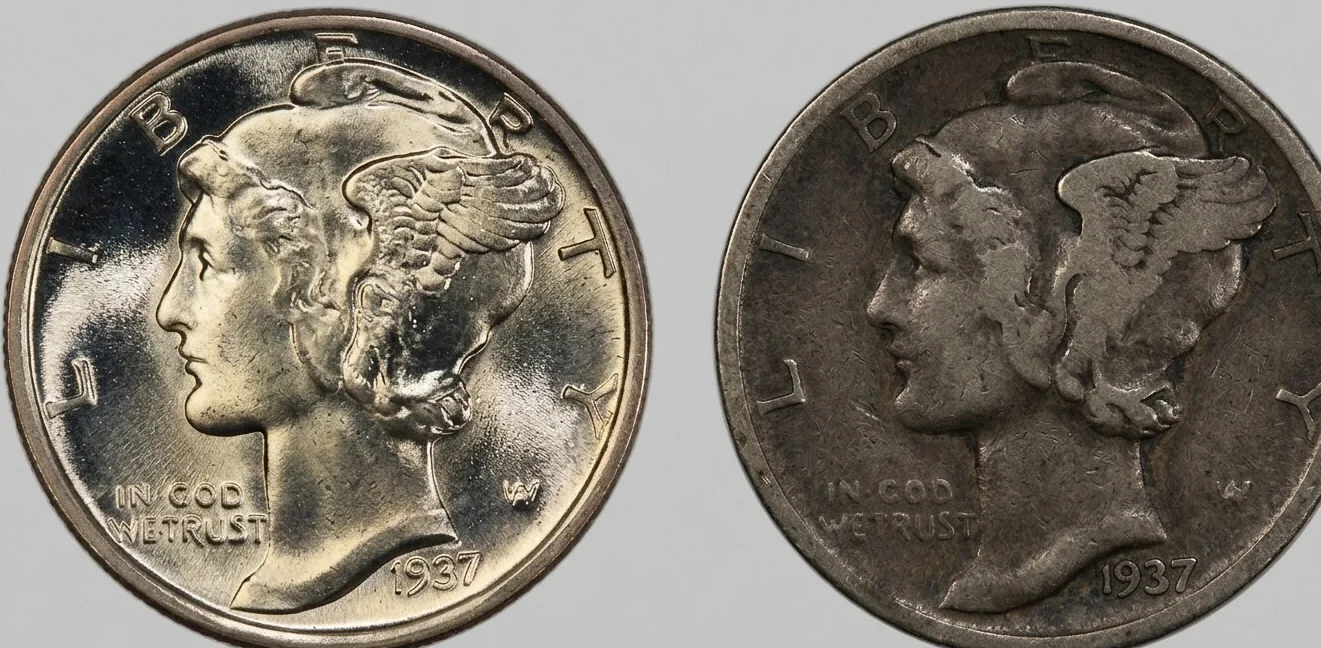
Metal Preservation and Toning
Silver content reacts chemically with atmospheric conditions.
The resulting oxide layer influences final grading.
Toning Free Coin App Classifications:
- Target Toning: Concentric color rings. Increases auction value by 20-50%.
- Black Oxidation: Resulting from improper storage. Reduces liquidity by 30%.
- Blast White: Surfaces showing no oxidation. Preferred by institutional investors.
Natural aging process → Creation of unique surface patterns.
Chemical cleaning → Total loss of numismatic value.
Comparative Rarity Analysis
Examining 1937 output alongside adjacent years clarifies its hierarchical position.
1936 (P) → 87,500,000. 1937 (P) → 56,850,000. 1938 (P) → 22,190,000.
Mintage reduction in 1938 identifies 1937 as a transition period.
Market status for 1937 remains “Common Date” with high scarcity in mint state.
Certification Impact on Liquidity
Selling raw 1937 dimes involves risks regarding inaccurate grade assessment.
Professional laboratory services standardize the trading asset.
Encapsulation benefits:
- Mechanical damage prevention.
- Composition authenticity verification.
- Registration in public population reports.
Service costs → $35-$55 per unit.
Certification feasibility begins at the MS65 threshold.
Circulation Wear Factors
Active usage of 1937 dimes continued until the mid-1960s.
Wear follows a standard pattern for this specific relief type.
Degradation Sequence:
- Hair above Liberty’s ear → Initial smoothing.
- Feathers on the cap → Loss of individual barb detail.
- Central fasces bands → Merging of horizontal lines.
- Axe head extremities → Rounding of sharp corners.
Fine (F12) condition → 40% relief loss.
Extremely Fine (XF40) → 90% detail retention.
Auction Methodology
Rare 1937 specimens trade via specialized platforms.
Participation requires understanding the Buyer’s Premium structure.
Standard premium → 17.5-20%.
Hammer price often excludes final transaction costs.
Calculation Example: Hammer: $1,000 Premium: $200 Total: $1,200
Price history analysis must incorporate these additional expenses.
Catalog Trends
Red Book and Blue Book annual updates reflect verified US show transactions.
Three-year trend summary:
- Price stagnation for MS64.
- Upward adjustment of 6-8% for MS68.
- Increased scarcity rating for Proof strikes.