
The 1944 Lincoln wheat penny sits at a turning point. After the one-year steel experiment in 1943, the U.S. Mint returned to copper-based planchets. Production surged to refill circulation fast. The result was scale: more than two billion cents struck across Philadelphia, Denver, and San Francisco. That scale explains why in most cases the 1944 penny value is ordinary—and why a tiny fraction stands far apart.
Understanding this year starts with one principle: composition and production errors define value, not age. Most 1944 cents are copper and plentiful. A handful are not.
The Big Picture: Mintage and Metal
All regular-issue 1944 cents were struck in a 95% copper alloy (with zinc and tin), weighing about 3.11 grams and non-magnetic. Mint totals were massive:
- Philadelphia: ~1.04 billion
- Denver: ~430 million
- San Francisco: ~282 million
These numbers cap premiums for standard coins. Even well-preserved examples remain accessible.
What “Normal” Looks Like
A normal 1944 penny shows familiar traits:
- Copper color (brown to red)
- Weight around 3.11 grams
- No attraction to a magnet
- Clear wheat ears on the reverse
Use the coin identifier app to prove all those features while evaluating. In circulated grades (VF to XF), prices usually sit between $0.10 and $1. Mint State coins bring more, especially with original red color, but they remain affordable compared to true key dates.
Condition Still Matters—Within Limits
Because supply is so large, condition creates tiers rather than leaps.
Typical ranges for copper issues:
- VF–XF: $0.10–$1
- AU: a few dollars
- MS-65 RD: roughly $10–150, depending on mint and eye appeal
Minor doubled dies exist and add modest premiums when clearly attributed, but they do not transform a common coin into a rarity.
Where the Story Changes
The line between normal and outstanding appears when the wrong metal or the wrong mintmark punch enters the picture. Leftover steel blanks from 1943, overmintmarks, and foreign or silver planchets create coins that were never meant to exist. These are the pieces that command five- and six-figure results—only when verified.
Outstanding 1944 Pennies: Errors That Redefine Value
The premium end of the 1944 penny market is driven by coins that break the rules. These are not condition upgrades of common copper cents. They are wrong-metal strikes and mintmark anomalies created during a rushed return to copper after 1943. Documentation, diagnostics via the coin app, and further certification decide everything here.
1944 Steel Cents: The Benchmark Rarity
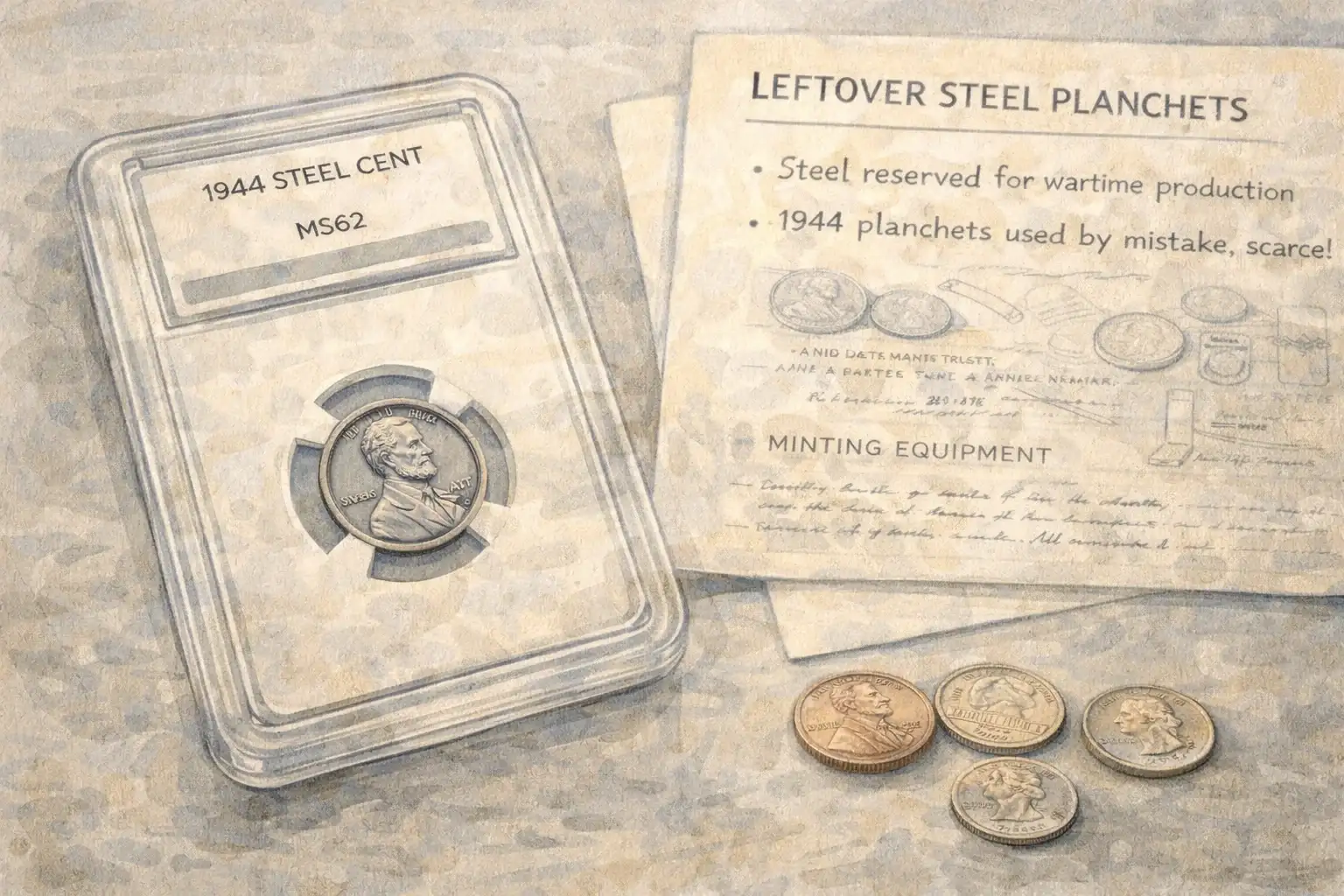
A tiny number of zinc-coated steel planchets from 1943 remained in hoppers and were struck in 1944. These coins look similar to 1943 steel cents at a glance, but the date confirms the anomaly.
What separates real examples from fakes:
- Magnetic response: steel sticks; copper does not
- Weight: ~2.7 g for steel vs. 3.11 g for copper
- Surface: dull gray with zinc wear patterns, not plated copper
Known populations are extremely small:
- Philadelphia: ~20–30 survivors
- Denver: ~7–10 survivors
- San Francisco: only 2 confirmed
Prices reflect that scarcity. Certified Philadelphia examples cross $100,000. Denver pieces exceed $200,000. San Francisco coins have reached $400,000+ at auction. Raw claims carry near-certain risk.
Overmintmarks: 1944-D/S
Another standout is the 1944-D/S overmintmark, where traces of an “S” remain beneath a Denver punch. This occurred as dies were repurposed during heavy production.
Key diagnostics include:
- Curved remnants of the “S” within or below the “D”
- Sharp, original luster on high-grade examples
- No tooling or altered surfaces
Values vary widely by grade and eye appeal. Lower mint state pieces start around $1,000, while MS-66 RD examples have approached $50,000.
Wrong Planchets and Other Freaks
A smaller but legitimate niche includes cents struck on silver dime planchets (about 2.5 g, ~17.9 mm). These show off-metal color and reduced diameter and have realized $2,000–7,500 when certified. Other errors—off-centers, broadstrikes, die breaks—fill a $100–1,000 range when clean and original.
How to Spot Outstanding Pieces and Avoid Costly Mistakes
The gap between a normal 1944 penny and an outstanding one is wide—and easy to miss without a process. Most errors advertised online are misidentified copper cents. A disciplined workflow keeps attention on the few coins that merit deeper review.
A Practical Screening Checklist
Start with objective tests. They eliminate almost every false lead in seconds.
- Weight: 3.11 g points to copper; ~2.7 g suggests steel; ~2.5 g raises silver-planchet flags
- Magnetism: steel attracts; copper and silver do not
- Diameter and thickness: off-metal strikes often measure short or thin
- Surface integrity: look for original metal flow, not plating or tooling
Next, inspect mintmarks and the date with a 10× loupe. Overmintmarks show rounded, integrated remnants—not sharp scratches. Doubled dies show separation, not flat shelving.
Certification Is Non-Negotiable for Standouts
Five-figure coins require third-party verification. PCGS and NGC holders establish authenticity, grade, and liquidity. This is essential for:
- 1944 steel cents
- 1944-D/S overmintmarks
- Off-metal planchet strikes
Raw “steelies” and altered mintmarks dominate online marketplaces. Avoid them. Provenance and slabs protect capital.
Using Digital Tools to Triage Finds
When sorting dealer trays, estate lots, or inherited jars, speed matters. The Coin ID Scanner app offers freemium photo identification on Android and iOS. A single image returns a coin card with year of minting, coin type, composition, diameter, weight, edge, and an indicative price from a database of 187,000+ coins—useful for flagging 1944 candidates that deserve closer testing.
As collections grow, the app’s collection management helps track outliers and duplicates. Premium smart filters and the AI Helper support comparisons and research without replacing hands-on verification.
Smart Buying Strategy for 1944 Pennies
Allocate budget where probability meets payoff.
- Normal copper cents: buy clean examples for type sets
- Minor varieties: pay modest premiums only when diagnostics are clear
- Major errors: buy certified or walk away
A focused approach avoids overpaying for common coins and keeps funds ready for legitimate opportunities.
Evaluating 1944 pennies is about discipline. Most are ordinary copper survivors. A few are extraordinary errors born from a hurried transition year. Weight, magnetism, diagnostics, and certification separate the two. Collectors who follow evidence—rather than claims—build sets that are both accurate and valuable.